Knowledge pillar
What if AI were a democratising force?
It does not create ideas where there are none. It lets more people turn an intuition into a project — and that shift runs deeper than any technical revolution.
2026-07-30 — 5 min read
Lire en français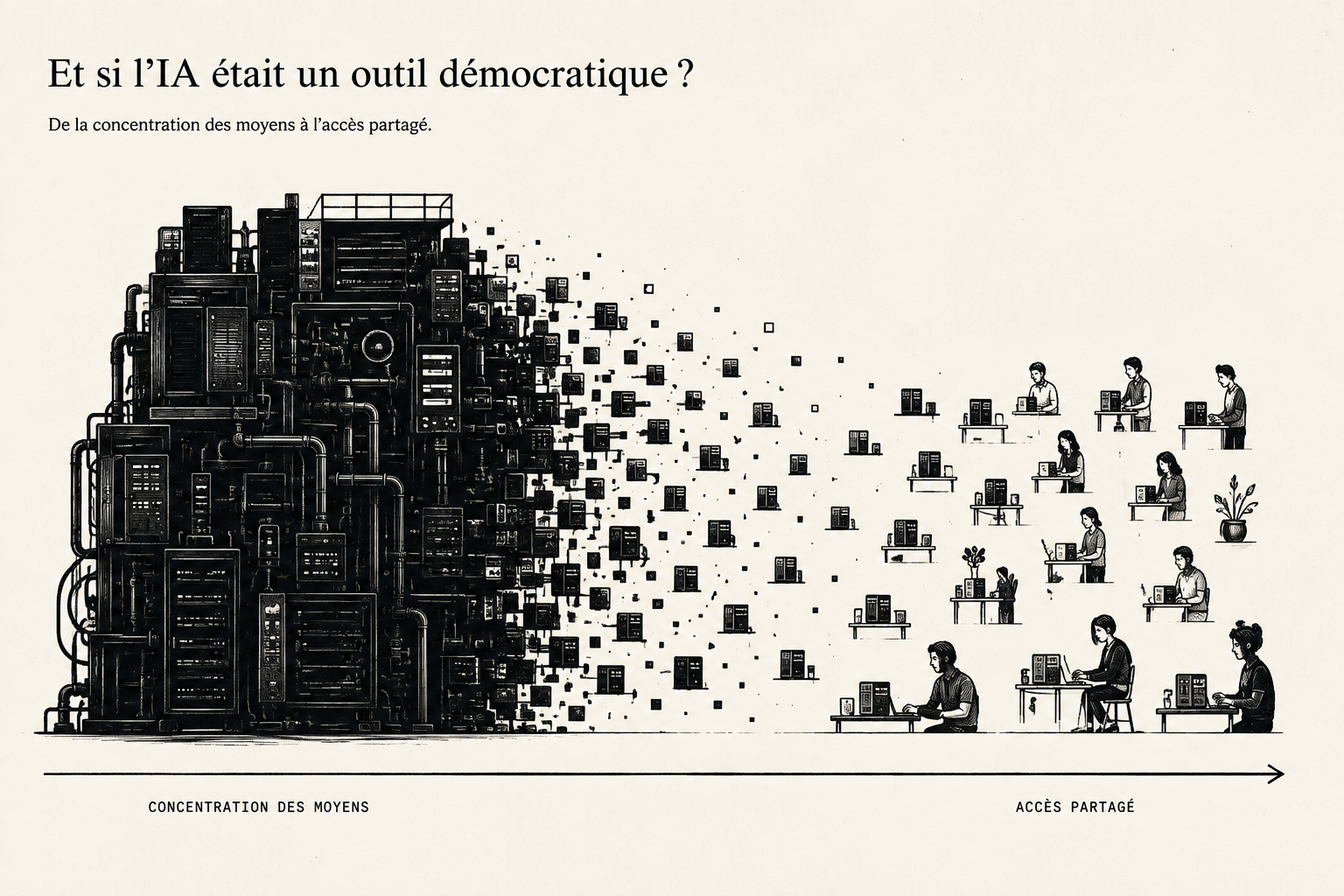
Artificial intelligence is sold as a technical revolution. It could be something else: a democratising force.
It does not create ideas where there are none. It lets more people turn an intuition into a project, an ambition into action, a vague thought into something concrete.
What used to stand in the way
For a long time, an idea stalled for want of knowledge, means or confidence. You had to know how to write, code, design, structure, communicate — or simply know the right codes. Many gave up before starting.
AI lowers some of those barriers. It lets someone who cannot code ship a first prototype. It helps someone who doubts their writing put their thinking into words. It supports someone with a vision but no idea how to organise it.
It does not replace the desire to make something. It gives that desire a way through.
What it changes in practice
The figures are starting to show the scale. According to the half-yearly barometer from Bpifrance Le Lab published in January 2026, 55% of French micro-businesses and SMEs say they use generative AI, against 31% a year earlier and 15% at the end of 2023. Usage has more than tripled in two years.
What the headline number hides matters more. Among the micro-businesses and SMEs that do not use it, 65% simply say they see no use for it in their company. Not price, not technique: the obstacle is not seeing what you could do with it. That is precisely the wall in question here — the one that stops people before the attempt.
This shift is not visible in the spectacular cases doing the rounds, but in ordinary gestures. The craftsman who finally presents his trade properly. The freelancer who drafts her own documents. The shopkeeper who handles his own communication instead of farming it out.
None of them acquired the skills they lacked. They went around a wall that used to stop them before they even tried.
Let us not kid ourselves: some work really is disappearing. What cost a lot yesterday — formatting, translating, drafting, producing a first version — now takes minutes. That work is not transformed, it is deleted.
What opens up instead is another path. The barrier to entry has fallen, and costs with it: what once required a budget can now be attempted for almost nothing. The opportunity is not to do the same thing faster, but to try what you once ruled out.
What it does not change
What disappears is execution — not judgement. Creating a useful product still takes persistence and a real grasp of the problem. Writing a good text takes thought. Building demands choices, sacrifices, work.
It does not replace skill: it multiplies it. The corollary is harsh. Without real expertise, it quickly produces passable work. The threshold it lowers is the one at the door, not the one at the top.
What it does unlock is something nobody had: a universal capacity to understand and to be understood. Reading a contract, grasping a technical text, framing a request in the expected terms, writing in a language you do not speak. That was never a matter of talent but of access — and access has just changed hands.
AI moves the starting point, not the finish. It gives a handhold to anyone left standing in front of their idea with no idea where to grip it. Everything that comes after remains untouched.
The caveat that matters
None of this is secured, because none of this belongs to us.
Training a foundation model takes capital, computing power and electricity on a scale that almost nobody can muster. The result is inevitable: a handful of players decide what these tools can do, what they refuse to do, what they cost and when they disappear. An instrument of emancipation rented from a third party that can rewrite the rules overnight remains an instrument of dependence.
We have seen this story before. Free software did not win by building operating systems more powerful than the vendors’ — it won by making its own impossible to confiscate. Nobody can pull Linux off the market, or change its licence retroactively, or decide it will cost twice as much next year.
The same divide is playing out today, and it is not lost. Mistral publishes the weights of Mistral Large 3 under the Apache 2.0 licence — a 675-billion-parameter model, available on Hugging Face, downloadable, runnable at home, modifiable, with no usage fee. These are not demos: they are models you can run on your own infrastructure, and that nobody can take back.
That is the real dividing line. Not between AI and its absence, but between tools you use and tools you own.
What it gives back
Used as a tool of emancipation, AI widens the circle of people able to produce, to understand and to act. It gives value back to the idea itself.
Not the perfect idea, already mastered and profitable. The fragile, unfinished, clumsy idea — the one its author would never have dared pursue.
AI is then less a machine that replaces than a tool that reveals. It does not make our limits disappear. It helps us stop being defined by them alone.
Perhaps this is what was missing. Not a weapon against anyone, but a tool anyone can pick up — provided it remains within reach. That is the whole question, and it will not answer itself.
The review
Get the next issues.
A few pieces a year, nothing else. No follow-ups, no promotions.