Funding pillar
Productive independence: the end of capitalism?
Productive independence means holding enough means of production to work without selling your labour to whoever owns them. A crack has opened in the separation Marx described — here is what opened it, and what could widen it.
2026-08-14 — 8 min read
Lire en français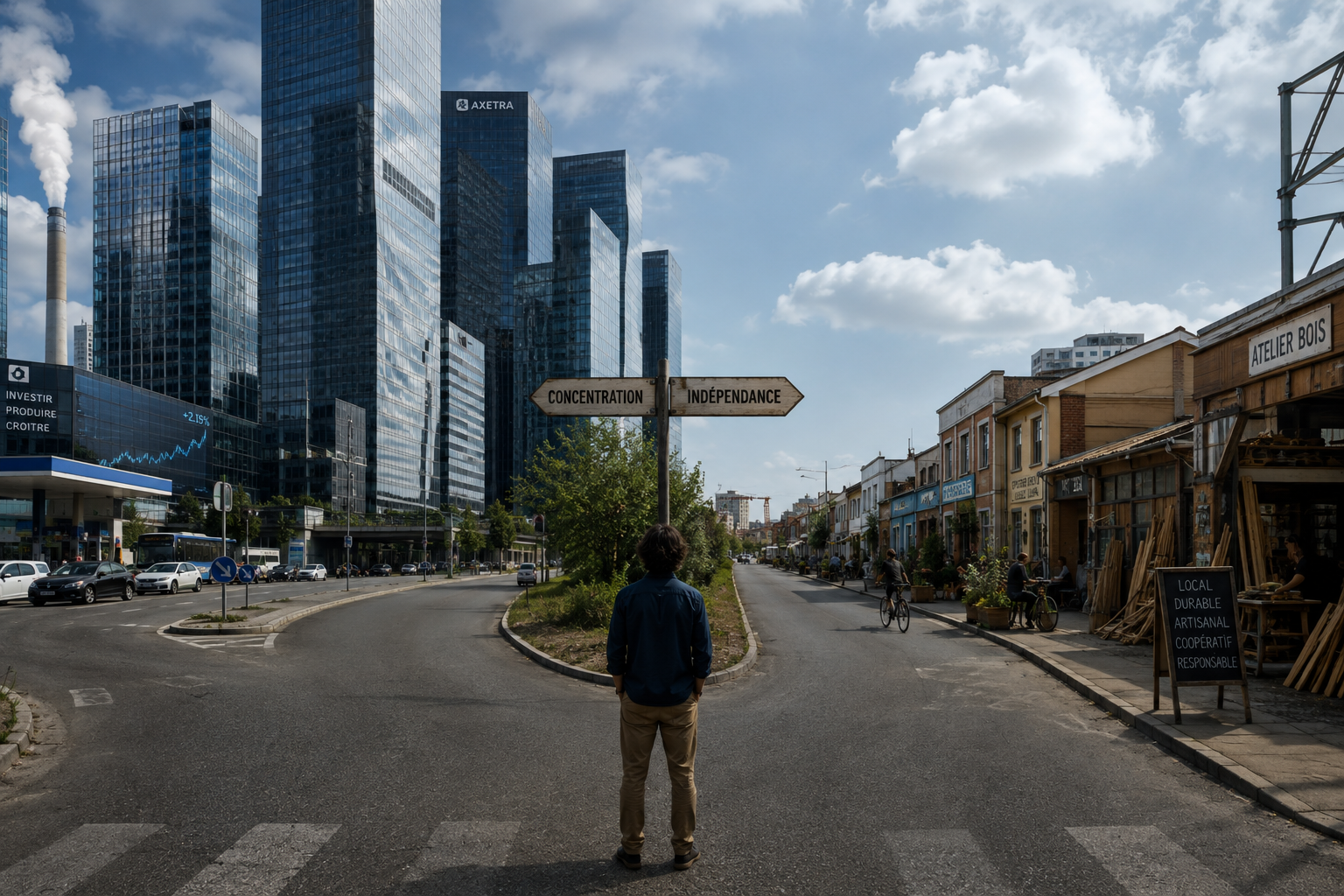
Two great answers are usually offered to the question of ownership. On one side, capitalism: whoever owns the capital owns the means of production, and employs those who do not. On the other, communism: those means become collective, historically most often through the state.
But that opposition was conceived in a world that has changed profoundly. The means to produce, to learn, to raise money, to find customers and to coordinate are becoming available to far more people.
A crack has opened.
What if that crack were gradually narrowing the separation between those who own the means of production and those who produce?
What Marx saw: the separation from the means of production
Marx identified, among other things, the separation between labour power and the means of labour. Whoever does not own what is needed to produce must sell their labour power to whoever does. The means of production, in his account, end up "commanding the producers".
In the industrial era, producing required factories, machines, capital, raw materials and access to markets — which concentrated the means of production in very few hands: those who owned them employed those who did not.
Capitalism grew in a context of capital accumulation and unequal access to resources and markets, shaped too by empires, colonisation and economic networks long reserved for a minority.
The point here is not to retell that history. It is to look at what has changed since.
A crack has opened: why producing costs less than it used to
Take software. A few decades ago, building and distributing a computer product to thousands of people required a company, servers, several trades and serious money.
Today one person can draw on free software, rent global infrastructure for a few dozen euros a month, and use artificial intelligence to do part of the work once split between several people.
The shift goes beyond software. 3D printing and digital machining bring certain industrial capabilities within reach of small workshops. The internet opens access to an immense body of knowledge. Social networks make it possible to reach an audience directly. Crowdfunding and pre-orders make it possible to raise capital before producing anything at all.
It is no longer only the tool of production that is becoming available. It is, step by step, everything that makes producing possible.
None of this covers everything, of course. You do not build a train, a power station or a semiconductor plant on your own. Some production will always demand large organisations and considerable investment.
But elsewhere, the cost of entry is falling.
That crack is what interests me.
What is productive independence?
Productive independence is having enough means at your disposal to produce without having to sell your labour power to whoever owns them. It does not require owning everything, making everything, or working alone: it can be individual or collective, and it is measured by the power you hold over what you produce.
The return of freelancers, craftspeople and small outfits could be read as a regression towards the small proprietor. That would forget that today’s small producer no longer works with the means of their nineteenth-century counterpart.
A leatherworker can make goods in their workshop and sell them in several countries. A creator can reach thousands of people directly. One person can build software used all over the world. A small team can run infrastructure once reserved for large companies.
They remain small in size, but no longer necessarily in what they can produce.
That is what I would call productive independence.
This independence can be individual or collective. Infrastructure, a machine, a network or funding can be pooled when their scale exceeds that of one person. Autonomy does not mean solitude.
One objection comes immediately: this kind of production often costs more. An object made by a craftsperson rarely sells at the price of its industrial equivalent. But that comparison assumes incomes stay organised as they are today. If more producers capture a greater share of the value of their own work directly, the question of price looks different. What matters then is not only what we pay for what we buy, but where the value we produce ends up.
The strength of coordinated numbers: when small means add up
The most powerful players have never held money alone. Their strength also comes from their networks, their knowledge, their information and their capacity to coordinate.
Part of that advantage is becoming more widely available too. The internet makes it possible to learn, to meet people, to publish, to find customers and to join communities that your background would not necessarily have opened to you.
Even funding is shifting. Crowdfunding, pre-orders and community financing make it possible to add up small sums into capital that no single participant held.
GameStop gave a spectacular demonstration of this in 2021. Thousands of retail investors, each holding relatively little, coordinated online and managed to weigh against funds with vastly greater resources.
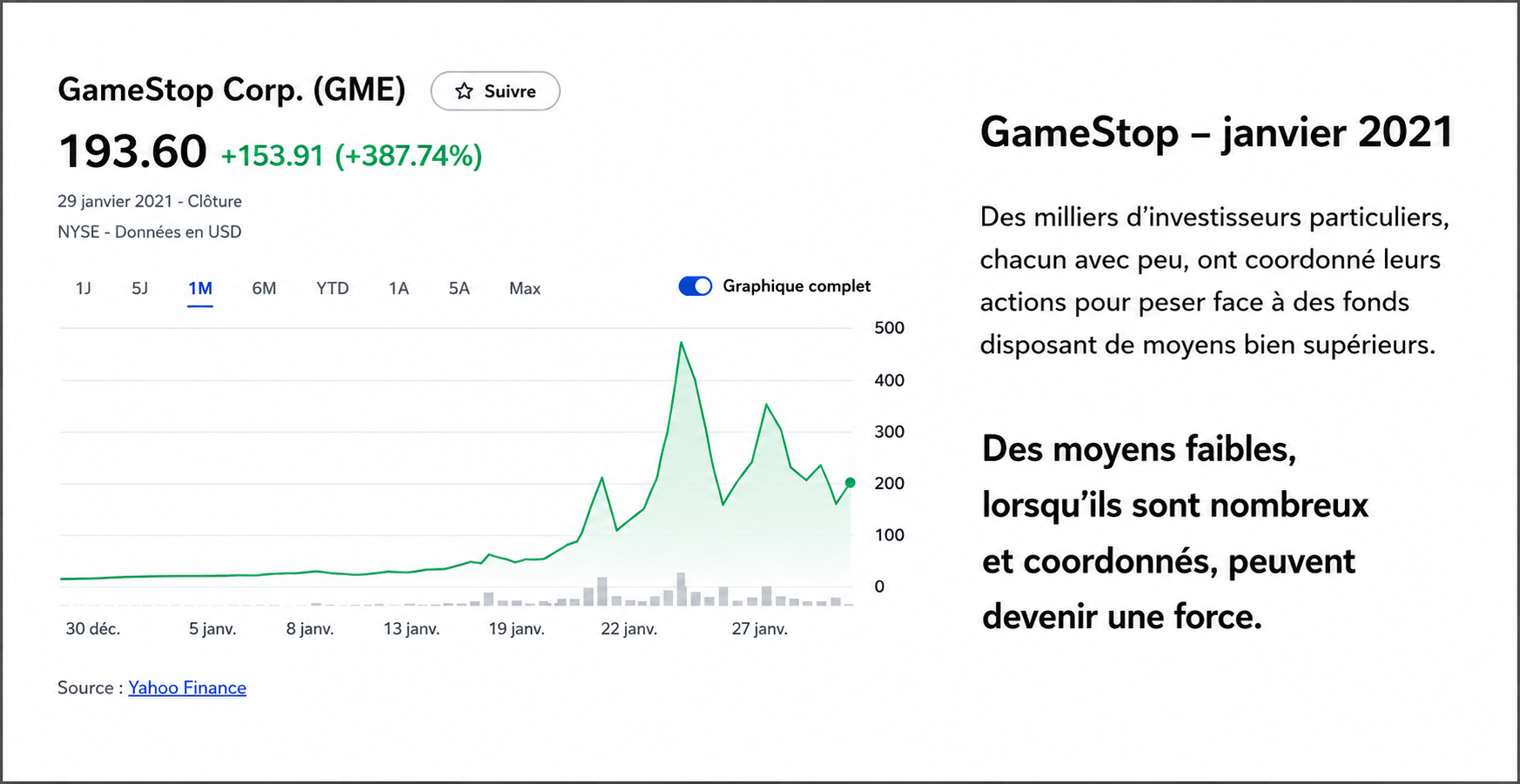
This is not a revolution. But the episode illustrates an essential mechanism:
Small means, when they are numerous and coordinated, can become a force.
Blockchain, for all its speculative excesses, is also experimenting with forms of exchange, funding and ownership that depend less on a central actor.
So the crack is no longer only about tools. It runs through funding, knowledge, networks and coordination.
One might object that some people will always seek to accumulate more wealth and more power. That is precisely where the balance can shift. If the capacity to produce is spread across far more people, those who concentrate capital face a mass of producers who depend on them less.
The point is not necessarily to make those who accumulate disappear. It is to reduce the power that accumulation gives them over those who produce.
From platform capture to productive independence
The gig economy looks like the obvious objection. In some sectors it has produced a social disaster: workers who are legally independent but economically dependent on a platform that controls their access to customers, sets the rules and takes its cut.
And yet the idea could have carried a very different promise: letting people offer their work directly and easily find those who need it.
The problem appears when whoever makes that meeting easier gradually takes control of it.
We distributed the work without distributing control of the infrastructure that organises it.

But the opposite movement already exists. A leatherworker, a craftsperson or a small manufacturer can use a marketplace or social networks to find enough customers to live on what they make, without owning a distribution network of their own.
That infrastructure still often belongs to some of the most powerful groups in the world economy. Which is exactly the next step: building more diverse and more sovereign alternatives, at a scale still to be defined.
They have nonetheless already proved something essential: a small producer can now reach a market that was once out of reach.
Stepping into the breach
None of this will overturn two centuries of economic organisation overnight. The concentration of capital and the balance of power remain immense.
But a crack has opened.
Producing with less capital, reaching knowledge, finding a market directly, gathering a community, funding a project and coordinating people are becoming possible at a scale they were not before.
We talk a great deal about what this shift will destroy: automation replacing workers, AI wiping out jobs, the internet creating new monopolies.
But perhaps we are only looking at half of the movement.
The capacity to produce is also being distributed.
This means neither the disappearance of large companies nor a world made only of freelancers. Some production will continue to require large organisations. Other production can be carried by individuals, companies, cooperatives, communities, or forms we have not invented yet.
Marx described the separation between labour power and the means to put it to work. We have obviously not abolished that separation.
But we may have begun to crack it.
This breach can be captured. Platform capture is already a warning. But it can also be widened, by building and pooling means that give more power to those who produce.
Productive independence is not yet an alternative to capitalism.
The crack is there. It is up to us to step into it.
The review
Get the next issues.
A few pieces a year, nothing else. No follow-ups, no promotions.